Design and working
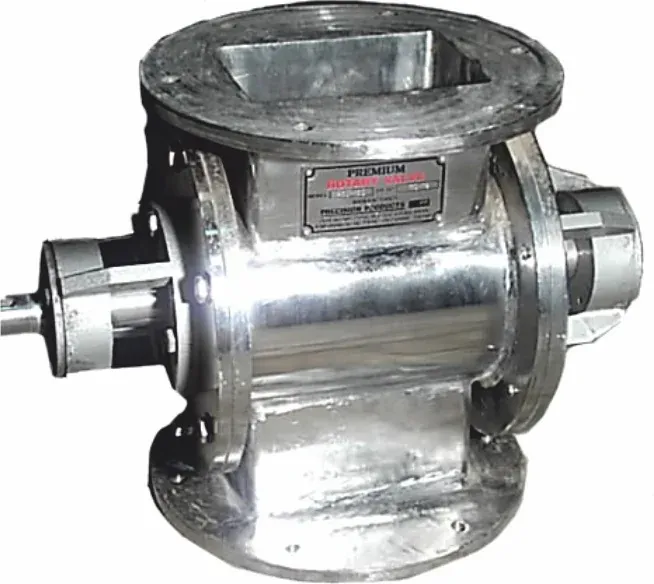
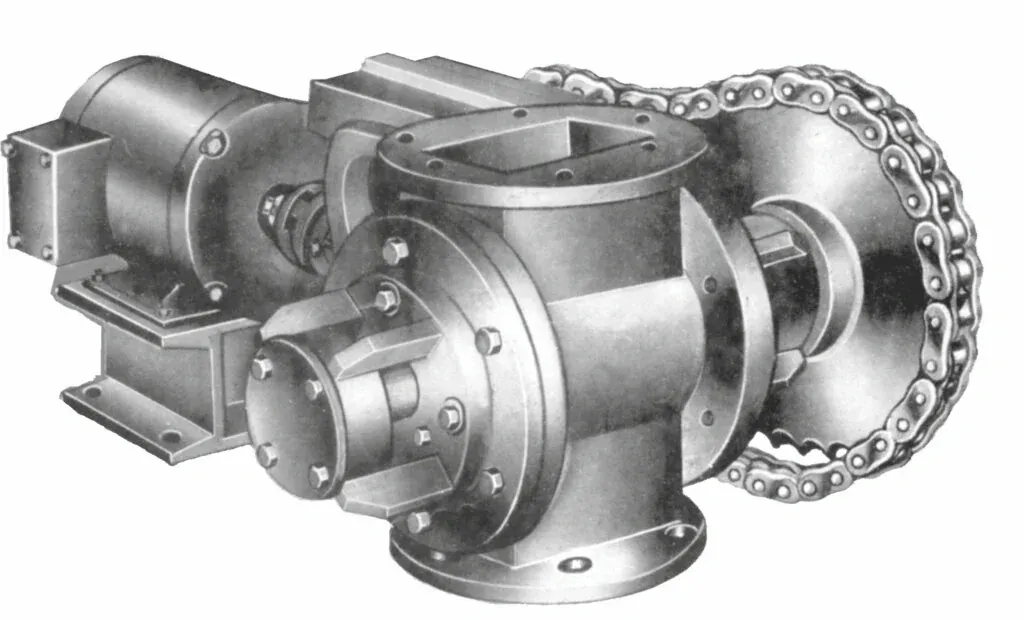
A rotor with precision-machined vanes turns inside a cast housing. Material falls into the pockets between vanes and is carried round to the outlet, where it drops by gravity. Close clearance between vanes and housing minimises air leakage, so the valve also works as a rotary feeder for uniform discharge. Body and rotor are made in cast iron or stainless steel, with surface treatments for abrasion or corrosion resistance.
Applications
- Pneumatic conveying systems
- Dust filtration units and cyclone collectors
- Batching and mixing
- Discharge from silos, bins and hoppers
Technical specifications
| Model | Power (HP) | Body ID (mm) | L × B × H (mm) | Capacity (t/hr)* |
|---|---|---|---|---|
| PRV 0 | 1/2 | 105 | 120×75×250 | 0.6 |
| PRV 00 | 1/2 | 150 | 160×115×325 | 2 |
| PRV 1 | 1/2 | 210 | 200×150×400 | 5 |
| PRV 2 | 1 | 265 | 250×175×450 | 10 |
| PRV 3 | 1 | 315 | 300×195×500 | 18 |
| PRV 4 | 1.5 | 400 | 400×270×550 | 38 |
| PRV 5 | 1.5 | 450 | 450×300×600 | 57 |
| PRV 6 | 2.0 | 500 | 625×315×670 | 80 |
*Capacities are based on cattle feed of density 0.6 g/cc and vary with the material. Tailor-made and higher-capacity valves are available.
Gallery