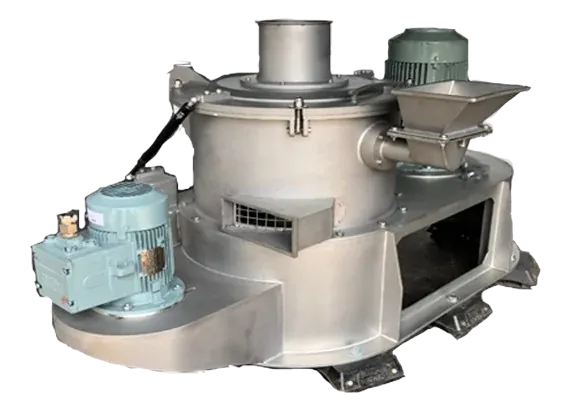
Operating principle
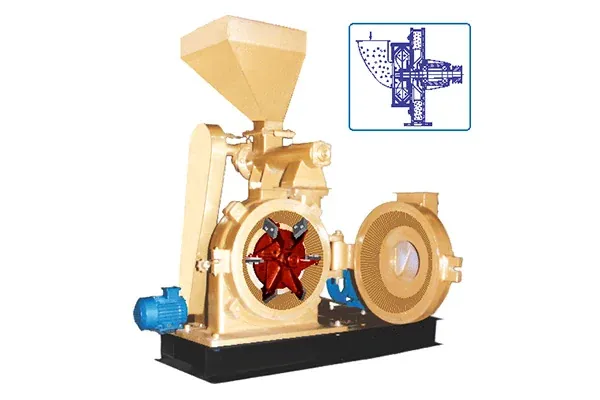
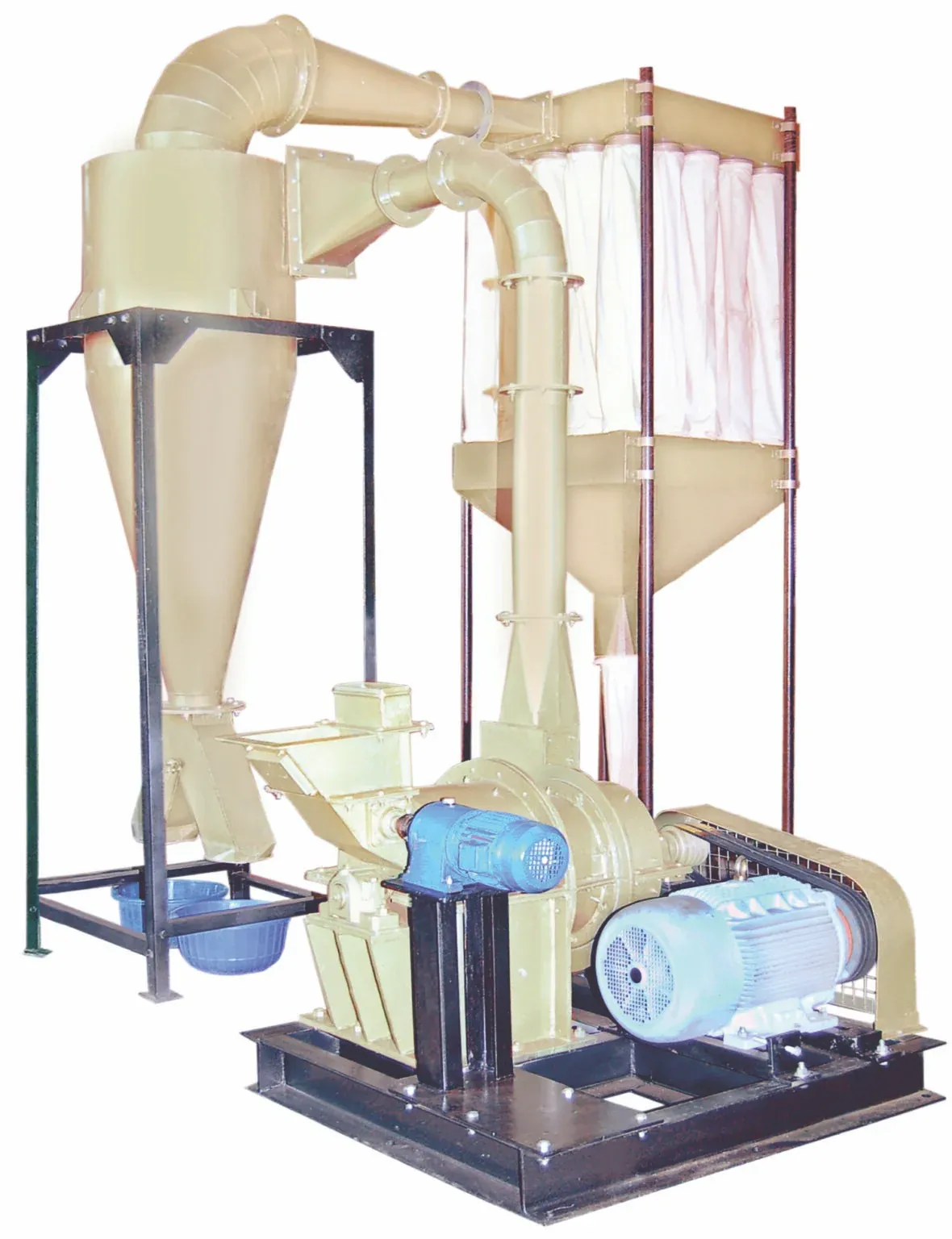
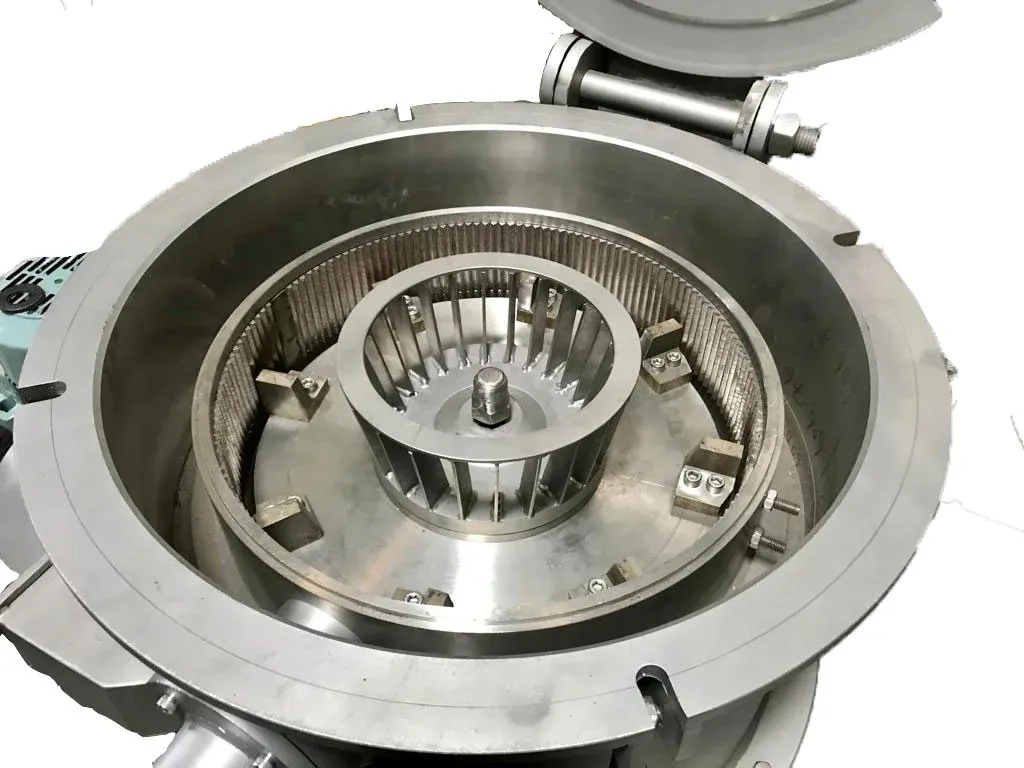
A variable feed screw delivers material to the grinding chamber, where hammers strike it at high velocity against the liner. Primary air entering below the rotor via a baffle ring carries particles up the liner wall, past a shroud ring, and a dispersion ring deflects them into the separator wheel. Two opposing forces act on each particle: the drag of the air flowing inwards and the centrifugal force of the rotating separator. Fine particles follow the air out as finished product; coarse particles are rejected back to the grinding zone by the secondary air stream. Fines are collected in a pulse-jet dust collector and discharged through a rotary airlock valve.
Why choose an air classifying mill
- 3-in-1 unit — milling, size classifying and conveying, with on-line adjustment.
- Air or mechanical (screw/conveyor) feeding to suit the application.
- Main rotor and classifier are separate units, reducing blockages.
- Jacketed main grinding chamber to control temperature.
- Air-purged classifier reduces product trapping between classifier fins and top cover.
- Totally dust-free operation; quick to clean.
- Large air volume suits heat-sensitive materials; inlet air can be heated (to dry moist feed) or conditioned for hygroscopic products.
- Closed-loop operation with nitrogen or another inert gas for potentially explosive materials.
Drive data
| Drive | PACM-1 | PACM-30 | PACM-45 | PACM-60 |
|---|---|---|---|---|
| Main drive (HP) | 10 | 30 | 45 | 60 |
| Separator drive (HP) | 2 | 3 | 5 | 5 |
| Feed drive (HP) | 0.5 | 1 | 1 | 1 |
| Fan drive (HP) | 7.5 | 15 | 20 | 25 |
| Rotary airlock drive (HP) | 0.5 | 0.75 | 1 | 1 |
Capacity and fineness are established by trial on your material. Specifications and design are subject to change without notice for improvement. Capacity depends on material, feed size, moisture and required fineness.
Applications
Powder coatings, toners, fine chemicals, pharmaceuticals, food products, minerals and other materials where the particle size distribution must be tight. See pigments & powder coatings and pharmaceutical.
Gallery
Frequently Asked Questions
What is the difference between an air classifier mill and a turbo classifier mill?
Both are screenless. The air classifier mill has an independently driven separator wheel, which gives the sharpest cut and on-line adjustment. The turbo classifier mill uses a gap plate on the main shaft for spiral classification — simpler, very effective for soft brittle materials (Mohs ≤ 3).
Can the air classifier mill grind heat-sensitive products?
Yes. Its large air flow and jacketed chamber limit temperature rise, and conditioned or chilled air can be used.