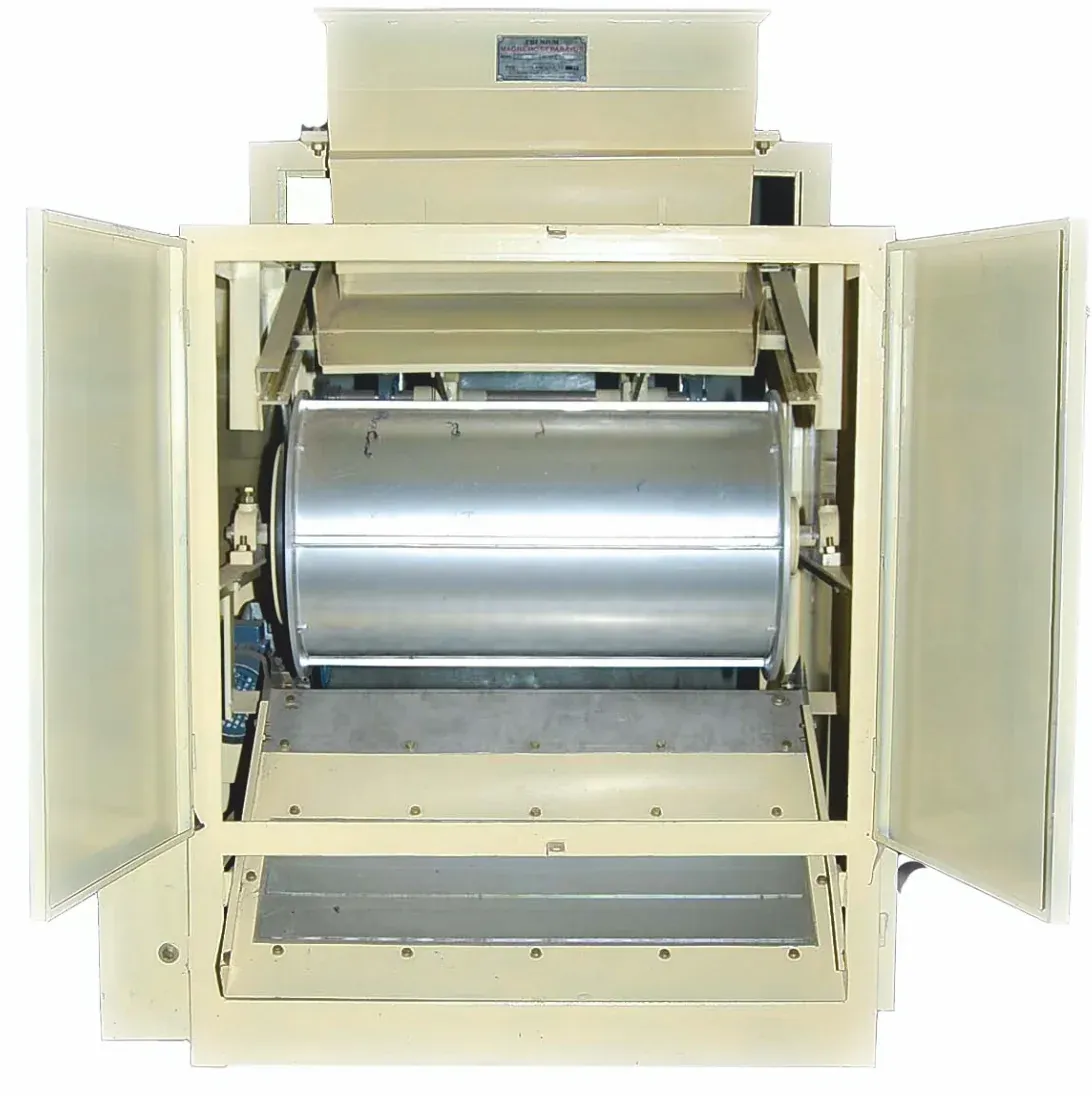
Working principle
A stationary magnetic assembly covers roughly half the drum circumference across its full width. A non-magnetic stainless steel shell rotates around it. Material fed evenly from a chute passes over the drum: non-magnetic material falls away, while ferrous particles stay on the shell until they are carried beyond the field and dropped separately. Permanent magnets keep their strength in normal operation and need no power supply.
Technical specifications
| Model | Capacity (grain) | Drum dia | Drum length | Motor HP |
|---|---|---|---|---|
| PPMDS 2 | 2 MT/hr | 400 mm | 600 mm | 1 + 0.5 |
| PPMDS 4 | 4 MT/hr | 400 mm | 750 mm | 2 + 0.5 |
| PPMDS 8 | 8 MT/hr | 500 mm | 1000 mm | 3 + 0.5 |
| PPMDS 12 | 12 MT/hr | 600 mm | 1250 mm | 5 + 0.5 |
| PPMDS 16 | 16 MT/hr | 600 mm | 1500 mm | 5 + 0.5 |
| PPMDS 25 | 25 MT/hr | 600 mm | 2500 mm | 5 + 0.5 |
Specifications and design are subject to change without notice for improvement. Capacity depends on material, feed size, moisture and required fineness.
Applications
Minerals, chemicals, food, flour, plastics, grains, sand, cement, fertilizers, abrasives, glass, slag, ores, rock and refractories.